Govt.
of Orissa has initiated a number of measures to make
agriculture better productive and remunerative. Moreover,
for this, access of land to small and marginal farmers
is necessary. Earlier State Govt. had taken minimal
steps of changing land policy to appease farmers. Nevertheless,
at present Orissa is among the few states, which has
adopted progressive Land Reform Act.
In order to discuss the various dimensions
of existing land policy for the poor and land less,
prospects of its revision, which may have a bearing
on agricultural production, a seminar on "Land
Policy for Accelerated Agriculture Growth and poverty
reduction in Orissa" was organized in Hotel Swosti
Plaza, Bhubaneswar.
Duration: 2-days seminar was held
on 5th & 6th September 2007
Objectives:
1. To review the existing land policy of Orissa and
the reform measures in a common platform of concerned
Govt. dept officials; NGO functionaries of state, national
& international arena; activists working on land
right issues and media people.
2. To recommend appropriate policy for land leasing
and allocation of homestead lands to poor and landless
families.
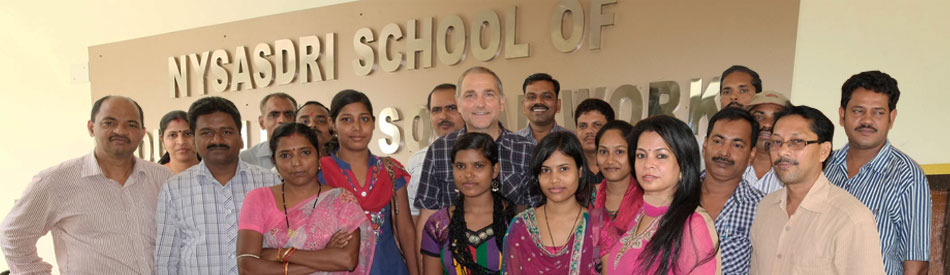
Organizers: NYSASDRI, a state level
Non Governmental Organisation had organized this congregation
of participants in collaboration with
# The Department of Revenue and Disaster
management , Govt of Orissa;
#Commission for Agricultural Costs and Prices (CACP),
Govt. of India;
#F.A.O, New Delhi; R.D.I, Bangalore and
#Utkal University, Orissa.
Participants:
A total of 83 participants representing from various
Govt. departments including Revenue and Disaster Management,
Agriculture, Commission of Agricultural Costs &
Prices. Also Minister of Revenue, functionaries of International,
National and State level NGOs, Academicians, Activists
from different forums, Media persons etc had participated
in this two-day programme.
Agenda: The seminar covered two technical sessions.
Presentations were made in two separate technical sessions
under broad themes of--
a. Allocation of Homestead plots to landless poor
b. Land leasing policy
c. Working group recommendation
RECOMMENDATIONS OF THE WORKING GROUP
1. Allocation of Homestead plots to landless poor
a. Form a Land Rights Task Force.
Government of Orissa should form a high-level Land Rights
Task Force to gather information and present policy
recommendations related to providing land rights to
the landless.
Composition: Representatives from the government, NGOs
and activists working on land rights, and researchers.
Objectives:
• Gather information directly from the field and
public meetings, through commissioned research, experience
of civil society organizations, and experience of other
states and countries.
• Develop specific recommendations and a proposed
time-bound action plan for providing land to the landless.
Research: Independent researchers commissioned to gather
and analyze data related to various topics, including
• Bhoodan land
• Endowment land
b. Make certain improvements to Vasundhara scheme
• Wife or women's name first on the patta
• Introducing land purchase mechanism in the models
of West Bengal, Andhra Pradesh, and Karnataka.
• Provide extra of land - at least 0.10 acre (and
up to 0.16 acre). Where eligible landless families are
already occupying government land to that extent, legitimise
that occupation, not just 0.04 acre.
• Providing land as close as possible to village
habitations. Where government land for allocation is
not available near the habitations, the land purchase
mechanism be used.
• Land received should be inheritable, but not
saleable.
• Prioritize female-headed families, especially
trafficking victims and widows.
• Govt of India to provide central funding for
such schemes
c. Civil society should fully involve themselves in
the Mo Jami - Mo Diha Campaign of the Revenue Department.
• NGOs and CBOs should respond to the government's
invitation in the August 28, 2007 Circular by:
• Raising awareness of villagers about the government
campaign.
• Helping the poor to prepare claims and grievances.
• Participating actively in the "Mo Jami
Mo Diha" Melas.
• Identify existing cases of the poor in the revenue
courts and assisting the poor through legal aid.
• Record oral evidence of the poor for the "Camp
Courts"
• Documenting the land related issues of poor
in the village where they reside
2. Land Leasing Policy for Agriculture Growth and Poverty
Reduction
• The poor can increase their income by farming
by taking the land on lease.
• Land leasing is linked with poverty reduction.
• Need of new policy initiative to ensure the
livelihood of the poor landless family of the village
through land leasing (in case of government land leasing
preference should be given to the poorest of the poor)
• Law does not recognize sharecropping in Orissa.
The govt should recognize sharecropper. Agriculture
Officer should issue the farmers an identity card.
• Leasing to outsiders should not be allowed.
It must be limited within the community and within the
same village. A special precaution must be required
in the scheduled area.
• Gram Sabha / Panchayat along with the local
civil society and the Rev. Deptt. Need to be authorized
to monitor the lease issues, so that no stake from outside
are allowed leasing in land.
• Government should accordingly review and amend
the existing law for legalization of land leasing in
the previously mentioned manner as soon as possible.
• Leasing to group is not allowed legally. However,
it is widely practiced in different parts of the country.
Only informal arrangement exists in the villages of
Orissa. Government should allow group leasing especially
to women SHG.
• Leasing in and leasing out of agricultural land
for agricultural Purpose within a defined village say
within 4 to 5 kms radius, within the farming community
and within ceiling need to be permitted legally.
• Establishing a separate Task force to monitor
the leasing issues involving people and Civil society
actors.
(You may request us for full version of the printed
report i.e. 20 pages on A4)
|